A guide to have a planned approach to digital marketing (beyond random posts and ads).
The topic at a glance:

Digital success for small and medium businesses (SMBs) isn’t about being everywhere. It’s about being consistent, human and strategic where it counts.
Running a startup or a small business today takes immense adaptability and grit. Along with those, it brings steep learning curves. Between managing daily operations and serving customers, finding time (and money) for marketing often feels overwhelming. And if we add in websites, social media, Google Ads, email and SEO to that, it can get out of control fast.
This is because most SMBs don’t have a digital roadmap. They have scattered tactics instead of a clear direction.
A digital roadmap isn’t another plan you’ll never follow. It’s about doing what matters using the right tools to build momentum sustainably and avoid the trap of “spray and pray” marketing.
A scalable, storytelling and data-driven roadmap helps you overcome the confusion that appears when you’re juggling too many channels.
The Chartered Institute of Marketing recently noted in their insight on Top 5 Marketing Challenges for 2025 (and how to overcome them) that, “With more data than ever before pumping through digital platforms, finding ways to interpret and draw insight from these data streams is vital, particularly in the current regulatory landscape.”
1. Start with listening to your audience’s story
Every digital strategy begins with empathy. Before you boost a post or redesign your website, you need to know who your customers are, what they care about and why they’ll choose your brand. When you know your audience’s journey, you can start crafting content that speaks directly to their aspirations. You can start with:
- Customer persona mapping: Find three to four key audience types (e.g. the busy parent, the eco-conscious buyer, the local collaborator).
- Social listening: Use free tools like Google Trends, SimilarWeb or Meta Insights to understand what people are saying or searching.
- Journey mapping: Chart how customers move from awareness to purchase to advocacy.
Once you’ve defined your personas and tracked audience sentiment, map each journey carefully. This shows where to focus your effort and how to guide your customers toward conversion.
2. Build an ecosystem that works for you
You don’t need to be everywhere; you need to be where your audience spends time. Your goal is to create a connected ecosystem where every channel reinforces the same message and purpose.
- Instagram & Facebook – for visual storytelling and community building.
- LinkedIn – for B2B, consulting and thought leadership.
- Google My Business – for local SEO and visibility.
- Email – for retention and engagement.
Find out how we can help clients audit their presence and prioritise their channels.
Having seen this play out across global organisations, we know that the hardest part of planning digital campaigns is rarely picking channels but deciding what to do first. Every team has ideas, every leader has priorities and the temptation to do everything at once is real. What helped us was stepping back and being deliberate about the sequence.
In practice, that meant doing one activity at a time. Modernising a client-facing website before scaling SEO, timing content around high-impact moments or coordinating new channels for employee stories and client wins, rather than launching everything in parallel. By focusing on the right things in the right order, the roadmap became something our teams could actually work with.
3. The digital roadmap framework
A digital roadmap gives your brand clarity, alignment and a scalable path to growth. At the beginning, it seems like a lot, but with the right partner, it becomes a seamless process.
The six-step digital roadmap
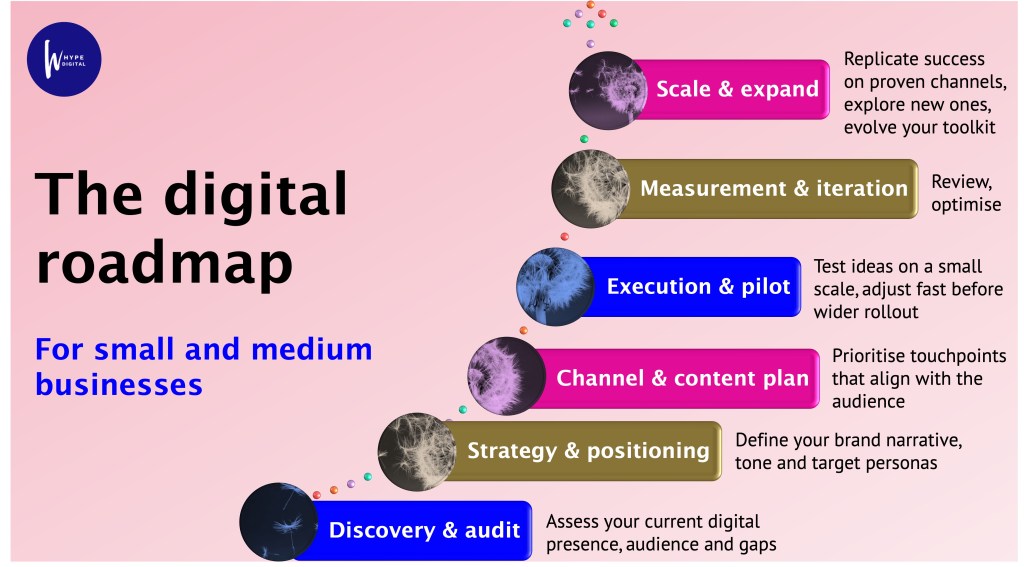
Discovery and audit, begins with assessing your current digital presence. It involves understanding your audience and identifying gaps that prevent growth.
In the strategy and positioning phase, define your brand narrative, tone of voice and core customer personas. This ensures every message feels purposeful and aligned.
With strategy in place, build a channel and content plan, prioritising only the platforms that matter to your audience currently. Don’t try to tackle all at once.
Next comes execution and pilot, where you test ideas on a smaller scale to learn quickly and minimise risk. This is to ensure when you do it at a larger scale, you know the pros and cons.
In measurement and iteration stage, focus on what works, refine what doesn’t and use data to guide decisions for a similar campaign or for the next release of the same campaign.
Once the foundation is proven, it’s time to scale and expand. Start by replicating successful activities across new channels. Continue refreshing your digital toolkit.
Create a roadmap that helps you focus on the most important marketing activities first. Talk to us.
4. Overcome common challenges
Many business owners stall at the early stages of digital marketing due to limited budgets, capacity and tech complexities. This can be very frustrating for them. Here are few steps on how to address the issues. If they are done consistently, small steps compound faster than you can imagine.
- Lack of defined priorities: Focus on what drives revenue or relationships.
- Budget constraints: Start small, pick one or two platforms first, focus on organic growth and reinvest wins.
- Time or capacity issues: Automate repetitive tasks or outsource to experts where needed (SEO, paid ads or analytics).
- Tech complexity: Choose tools with free onboarding and templates.
- Inconsistent execution: Create a monthly rhythm, i.e., plan > post > measure > refine.
5. Metrics that matter
After planning and execution are taken care of, it’s important to tackle how you measure. It’s very crucial to avoid the lure of vanity metrics and focus on the key performance indicators (KPIs) that show real impact:
- Customer Acquisition Cost (CAC) – how much you spend to earn a customer.
- Lifetime Value (LTV) – how much each customer brings back.
- Conversion Rate (CRO) – how well your funnel turns traffic into action.
- Engagement and retention – who’s coming back and why.
- Return on Investment (ROI) – what’s worth your continued effort.
Use dashboards provided by Google Data Studio or HubSpot to track visually.
6. Scale without breaking
Sustainable scaling means growing your systems and replicating your success, not reinventing it every quarter. Once you know what works, scaling should be deliberately and smartly done by:
- Replicating successful campaigns on new platforms.
- Increasing ad spend only when the ROI is positive.
- Adding automation carefully and selectively (without losing personal touch).
- Maintaining brand consistency even as you grow.
7. Keep it human and authentic
Your customers want to hear from you, not from an algorithm. That’s why we emphasise human-led content like behind-the-scenes/relatable stories, customer testimonials, founder insights and local collaborations. These small touches make your digital presence feel more human.
With the right strategy, your brand can feel as warm online as it does in person.
In conclusion, a digital roadmap helps you move from scattered efforts to scalable success. It’s not about doing everything. It’s about doing smart marketing that thrives on creativity, empathy and the smart use of free or affordable tools.
At Hype Digital, we believe great marketing doesn’t start with a post. It starts with purpose. We help ambitious SMBs build focused, human-first strategies that start with a purpose. Let’s map your digital growth together.
Additional readings
- Small business, big marketing: strategy that scales
- Lack of sales and marketing skills is the biggest threat to startup success
Let’s talk 👋
If you’re rethinking your marketing roadmap, we’d love to chat. Even a quick discovery call can help clarify your next step.