How can small and medium businesses (SMBs) leverage AI responsibly to increase efficiency, without losing the human touch?
The topic at a glance:

Beyond the AI buzz: what’s real, what’s useful
We’re living through one of the biggest shifts in marketing since the launch of social media. From big tech to SaaS companies — everyone is pushing AI-powered assistants and predictive insights.
Google has rolled out AI summaries in Google Search. Meta has launched AI agents across WhatsApp and Instagram. Canva, Adobe and HubSpot have started pushing automated content creation and personalisation. Microsoft has integrated AI into Office tools.
According to the UK Artificial Intelligence (AI) Statistics And Trends In 2025 report by Forbes, 79% feel that using generative AI has helped them at work, but 42% are concerned about the increased dependencies on AI and loss of human skills.
Many founders admit they experimented with AI at least once. They left it because the output felt generic and misaligned with their need. Generative AI has created enormous possibilities. Yet, it also causes confusion about whether to automate content creation. People struggle to stay authentic as algorithms increasingly influence marketing outputs.
Small business owners need to understand that AI is not here to replace their marketing brain. AI is here to remove friction to make their human-led marketing work better.
Where and how AI adds real value to SMBs
Most SMBs run marketing with limited time, tiny budgets and small teams. Often, one person, the founder, takes on multiple roles. They multitask as a salesperson, customer service rep, content creator and marketer. In scenarios like these, AI becomes useful because it reduces the pressure of execution.
| AI saves time | AI reduces cost | AI helps to decide |
| Writing first drafts of content, reusing long-form content into social captions, scheduling campaigns, analysing performance | Researching content ideas, competitors’ work, drafting emails, building social schedules/calendars (work that typically requires outsourcing to a freelancer) | Using Google Analytics to find which content/channel performs best and when to post, analysing patterns to predict who will to engage and convert |
McKinsey reports that employees are more ready for AI than their leaders imagine. In fact, they are already using AI on a regular basis; they are three times more likely than their leaders to believe that AI will replace 30 percent of their work in the next year; and they are eager to gain AI skills. This UK Business Advisors (UKBA) article, Digital Marketing for SMEs: What to Focus On (and What to Ignore), lists what we could achieve by adopting tools or using someone’s help.
Where AI should never replace humans
There’s an uncomfortable truth about AI. It doesn’t understand emotions; it approximates them based on data patterns. It can write a caption, generate a headline or suggest a visual by referring to its enormous database. But it can’t sense feelings, cultural nuances or trust/loyalty. Consumers can tell when they are reading content that’s AI-generated. As humans, we connect with perspective, vulnerability and belief — none of which can be artificially obtained.
This is where the danger lies. Businesses that blindly copy-paste AI content end up sounding generic. They sound like others who are using the same prompt. This approach gives content lacking a distinct voice. This results in businesses failing to form or keep an emotional connection with their audience/customers.
In recent projects, we’ve used AI selectively as part of our planning process. When exploring new ideas, teams often face pressure to move quickly from ideation to execution. We chose to treat AI as a sounding board: using it to stress-test early thinking, surface alternative perspectives and sense-check how ideas might land by leveraging its ability to scan and synthesise patterns across digital spaces. This broadened our perspective without outsourcing judgement or spending time on research. At no point did we let it decide on creative judgment — the intuition to move forward always remains ours.
At Hype Digital, our philosophy on AI is simple: AI cannot sense what humans can. Our lived experience, intuition and brand story are still our biggest differentiators.
Legal and ethical boundaries
The use of AI brings efficiency but also legal responsibility. This is the part where many small businesses unintentionally expose themselves to risk.
Ethical use of AI starts with copyright
Some AI tools scrape publicly available content, meaning an output could unintentionally resemble an existing copyrighted work, without you knowing. If you publish that content, you could be liable. AI outputs should always be viewed as drafts, not final assets. Editing, rewriting, reshaping and personalising content ensures originality and protects you from copyright infringement risks. It’s also important to use original brand assets like real people/events photos, employee/client testimonials and stakeholder/participant’s quotes.
Next is transparency
Under the UK’s Advertising Standards Authority (ASA) and the Competition and Markets Authority (CMA), brands must avoid misleading consumers. If AI-generated imagery or content alters perceptions, businesses may need to inform consumers. This is crucial when it could mislead someone about product capabilities or results. The business can add a simple disclosure line like “Image generated with AI for conceptual purposes” to meet compliance and maintains trust.
Finally, data protection
The UK GDPR and the new EU AI Act place strict boundaries around personal data. If you enter customer information into AI tools, you are responsible for protecting that data. Many free AI platforms store prompt history to improve their models. That means uploading personal or sensitive data can break GDPR regulations.
Key principle: Do not upload customer personal data into free AI tools. Ever. If you wouldn’t share it publicly, don’t share it with AI.
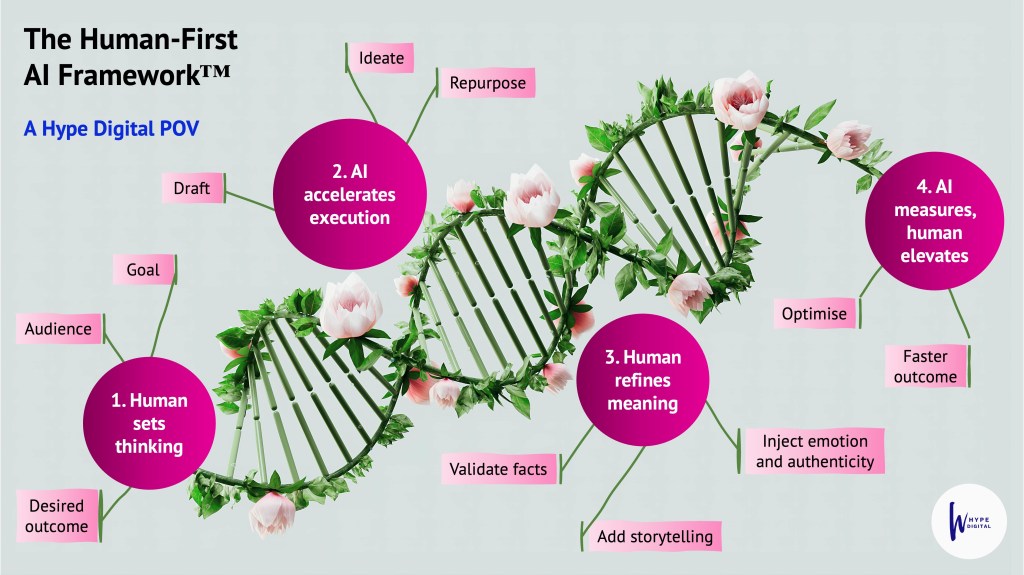
The Human-First AI Framework™
We help clients integrate AI without losing their authenticity or strategic thinking with our Human-First AI Framework™. This framework delves into human-first marketing and keeps AI as the assistant.
Step 1 – Humans set the direction.
Before any AI tool is opened, the marketer defines its narrative, goals, audience and message.
Step 2 – AI accelerates execution.
Once the direction is set, AI can generate first drafts, explore content variations and repurpose existing material into different formats. This stage is about producing content at speed and scale.
Step 3 – Humans refine, elevate and add meaning.
This is where human expertise comes in. An experienced marketer reviews the content, injects personality, adds storytelling layers and ensures alignment with tone and brand values.
Step 4 – Humans measure, AI optimises.
AI can assess performance patterns objectively and recommend improvements, while humans interpret those insights with context.
Simple, practical ways SMBs can start using AI in marketing
You do not need a complex tech stack to start. Begin with tools that reduce effort without compromising authenticity. Think of a core idea, either ask AI for suggestions or ask for a blog outline. Refine the outline as per your core idea and ask AI to draft a copy. Then, enhance the copy by adding your expert voice to bring it to life. Use AI personalisation to tailor messaging to audience preferences.
Here are starter applications that create immediate value of AI automation for small business:
| Activity | AI use cases | Example tools |
| Social content creation | Draft captions, hashtag ideas, repurposing content | ChatGPT, Canva |
| Design & visuals | Generate concepts, visual ideas, ad variants, creative automation | Canva, Adobe Firefly |
| Email campaigns | Draft sequences, subject line A/B tests | Mailchimp, HubSpot |
| Market research | Audience insights, keyword clusters | Google Gemini, Perplexity |
| Analytics | Forecast trends, identify high-yielding content | Google Analytics, HubSpot |
Many SMBs report that using AI frees up their time which they can use to focus on sales, partnerships, customer relationships and product innovation. If you’re new to structured marketing, read our Digital Roadmap article.
When AI is used correctly, it gives small businesses the tools big brands have access to, democratising execution. But authenticity, originality and emotional intelligence still sit firmly with humans.
AI is a powerful enabler, but the power remains with you.
At Hype Digital, we believe that the future of marketing is AI-assisted but human-led. If you want to integrate AI into your marketing, we’d love to support you. Our approach protects your authenticity. It also reduces your workload and keeps human ingenuity at the centre.
Let’s talk 👋
Let’s build your AI-assisted, human-first digital strategy together. Book a discovery call with Hype Digital.